

When We Don't Make the Mat
read aloud
When We Don't Make the Mat
There are different stages of human development. When we're children, it takes about 15 or 16 years before we are really beginning to understand our own personalities and develop our character. And even then, we're still little children compared to what life has in store for us in terms of experience.
It's unfortunate when we have rough childhoods, experience trauma, lack good role models, or encounter circumstances that set us off course, requiring us to spend a significant portion of our lives overcoming adversity before we can really begin to flourish.
Now, that doesn't mean that a good life doesn't involve adversity. All of us have problems that we have to face and struggles of different kinds.
We learn through repetition, both good things and bad things. It's unfortunate when we don't have influences early in our lives that guide us toward the proverbial or literal mat, where we learn to breathe, exercise, quiet the mind, and connect with the body.
Sobriety Was Only the Beginning
Even after I got sober at age 15, it would take me quite a long time before I found a quieting practice.
I was living my life and experiencing success in many areas, except that I had increasing levels of anxiety. You could look deeply into the history of my life and find conflict and reactivity nearly every step of the way.
I was still a child in many ways.
Like most people, I struggled in relationships. I had to learn everything from A to Z. I struggled not just with making money but with holding on to it. I had to educate myself in nearly every aspect of living.
Perhaps one of the most difficult things I struggled with was finding that observer self, the part of me that could look at my mind in action without immediately becoming attached to every thought it produced.
This is one of the harder concepts to grasp because you don't really learn it intellectually. You experience it, and that experience takes time, repetition, patience, and practice.
When we feel tremendous anxiety in life, we can easily become swept away by our circumstances. Trauma, financial pressure, relationship conflicts, children who are struggling, illness, bereavement, or even living in a city torn apart by warfare.
There are ten million things that can happen to human beings that we cannot anticipate, prevent, or control.
And yet, somehow, we have to learn how to live inside our own minds.
Yoga Is a Study of the Human Mind
The discipline of yoga, much like Tai Chi, is not merely about physical exercise. It isn't just about discipline, flexibility, strength, or what we eat.
It is also concerned with the psychology of the human mind.
Yoga invites us to examine consciousness itself.
How do we think? What obstacles exist in our minds? What habits and behavioral patterns do we have that lead us to struggle more than we otherwise might? Why do we repeat behaviors that we already know cause us suffering?
And at the center of much of this, in my experience, is anxiety.
We have it. It's there. It distracts us, guides us, influences our perceptions, and participates in our decision-making processes.
Sometimes it's valuable. Sometimes we need it.
Anxiety is not necessarily a mistake in our biological design. It is part of a protective system that helps us remain alert to potential threats. It helps prevent us from becoming a meal for a predator, motivates us to prepare for difficult circumstances, and sometimes pushes us to socialize, perform, and do better.
But anxiety is not the only mechanism through which the human mind can operate.
We can go beyond our automatic reactions. We can examine our conditioning. We can develop new behavioral patterns.
And perhaps we can learn to deviate, at least to some extent, from our programming.
The Controversial Subject of Free Will
This brings us to the controversial concept of free will.
We can become trapped in mental patterns that developed as a consequence of our lives and our karma. And when I use the word karma here, I'm referring to cause and effect.
When we're children, we have no control over who our parents are, as much as some people like to spiritualize the subject and suggest that we choose our parents before we're born.
We simply do not know that to be true.
You could say that there is a soul on its own spiritual journey, that it chooses particular experiences for its evolution, and blah, blah, blah.
But you can't prove any of that. And I don't find it particularly useful when I'm trying to understand the practical realities of human suffering.
In this life, we have to accept uncertainty, randomness, chance encounters, timing, circumstances, and what we commonly refer to as luck.
There are things we have no control over, and there are things over which we appear to have some degree of control.
For example, I can deliberately choose the next words I use in this article.
I could say fuck, shit, and piss if I want to.
I could say Namaste.
I could say, have a nice day.
Whether or not that constitutes absolute free will in the philosophical or neurological sense is another discussion. But I am interested in cultivating whatever degree of agency is available to me.
Free Will, One Breath at a Time
Learning to regulate the nervous system is, in my view, an exercise in practicing free will on a breath-to-breath basis.
Can I deliberately slow down my breathing?
Can I refrain from reacting to a thought?
Can I resist the impulse to say something hurtful?
Can I redirect my attention?
Can I bring myself back to the present moment after being carried away by a stream of anxious thinking?
These are practical exercises in developing agency.
It is also your decision whether or not you will have enough faith in the process to continue practicing, even when you don't immediately experience the results you're hoping for.
Over time, you may experience a breakthrough. You may discover a deeper state of mental relaxation.
Not necessarily answers.
Not necessarily greater wisdom.
You won't acquire supernatural powers. You won't be able to levitate above your yoga mat, fly across the sky, and touch the moon.
That's all bullshit.
There are laws of physics within which we exist, and we should enjoy that because the parameters of our existence are already extraordinarily wide.
We don't need supernatural abilities to have a remarkable human experience.
The Extraordinary Biology of Being Human
We're living in physical bodies with physical brains capable of producing thought.
There is chemistry inside of us influencing an extraordinary number of things.
What we eat, how we sleep, how we move, our neurons, enzymes, hormones, cells, the microorganisms inhabiting our digestive systems, the atoms that make up our bodies, and even the gluons, up quarks, down quarks, and other fundamental particles involved in the structure of matter are all part of the extraordinary symphony that makes us what we are.
And within all of this biological and physical activity, we possess a remarkable capacity: a mind that can think about itself.
I can sit here and say to myself, wow, I'm thinking about this.
Now I want to think about that.
I'm noticing that I'm angry.
I'm noticing that I'm afraid.
I'm noticing that I'm generating an imaginary conversation with someone who isn't even in the room.
I can observe what I'm doing. I can examine it. I can question it. Sometimes, I can interrupt it.
Consider how extraordinary that is without adding a single supernatural explanation to it.
Developing the Observer Self
One form of meditation brings us into a state in which we're simply observing the mind peacefully and quietly.
We're looking at it. We're listening to it. We're allowing thoughts to arise and pass without necessarily becoming involved in them.
We don't have to entertain every thought.
We don't have to argue with every thought.
We don't have to believe every thought.
We don't have to build an entire emotional experience around every piece of information that surfaces in consciousness.
A thought can arise, and we can simply return our attention to the breath.
Other forms of meditation and mindful practice involve deliberately meeting certain thoughts with a different message, redirecting our attention, or introducing a healthier perspective.
If I'm encountering a repetitive internal message that says:
I'm no good. I'm ugly. I'm terrible. I'm losing. I'm a failure.
I can practice meeting that message without resistance or hostility toward myself.
I can respond with something different.
At this particular moment, I'm breathing. I'm alive. My possessions and accomplishments do not determine my entire value as a human being. I have the capacity to love, to help, to forgive, to learn, and to change.
I can take responsibility for my mistakes.
I can paint. I can write. I can sing. I can dance. I can smile at a stranger. I can call someone I love. I can help another human being. I can sit quietly and take ten conscious breaths.
There are countless things we can turn our attention toward, even when we're experiencing considerable emotional difficulty.
The point is not to deny our suffering. The point is to practice directing our attention so that suffering does not become the entirety of our conscious experience.
What Happens When We Don't Make the Mat?
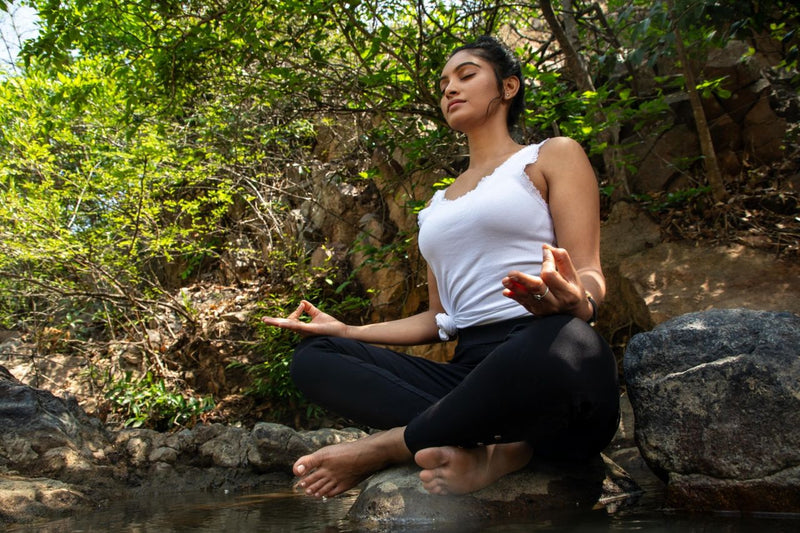
The mat is both a physical object and a metaphor.
Making the mat means showing up for the work of developing ourselves.
It could be yoga, meditation, Tai Chi, walking, conscious breathing, exercise, journaling, or deliberately practicing a healthier response to a difficult situation.
The mat is wherever we go to work on ourselves.
And it's important that we do this work not only when we're struggling but also when things are going reasonably well.
If we wait until our relationships are collapsing, we're experiencing financial devastation, someone we love has died, or we're overwhelmed by anxiety, we may find it considerably more difficult to begin learning the very practices that could help us navigate those experiences.
That is not to say that it's ever too late to begin, or that meditation eliminates the need for professional help when we're overwhelmed.
But there is tremendous value in developing these skills before a crisis arrives.
We practice breathing when we're comfortable so that we have some familiarity with conscious breathing when we're frightened.
We practice observing the mind when we're relatively peaceful so that we have a better opportunity to observe it when we're angry.
We practice gratitude when life is good so that gratitude remains accessible when life becomes difficult.
We practice concentration when the world is quiet so that we have some ability to concentrate when the world becomes chaotic.
If we never make the mat, we may spend our entire lives strengthening the very behavioral patterns from which we're trying to escape.
Prepare Yourself Before You Fall Into the Ravine
Life will present us with adversity.
There is no diet, spiritual philosophy, meditation practice, amount of money, or system of yoga that will exempt us from the fundamental difficulties of being human.
But we can work on our capacity to respond to those difficulties.
Turn your attention toward the things that bring you closer to mental balance. Do it repeatedly. Do it deliberately. Do it even when you don't particularly feel like doing it.
Develop the practice while you have the opportunity.
Because when you fall into a ravine, you don't want that to be the first time you've ever thought about learning how to climb.
Make the mat.
Namaste. Please try the split pea soup.

tap into our thousands of self-help blogs,
talk back